Catastrophic senior decision-making at Maghaberry raises serious questions over Minister’s Assembly statement, says Burrows
Catastrophic senior decision-making at Maghaberry raises serious questions over Minister’s Assembly statement, says Burrows
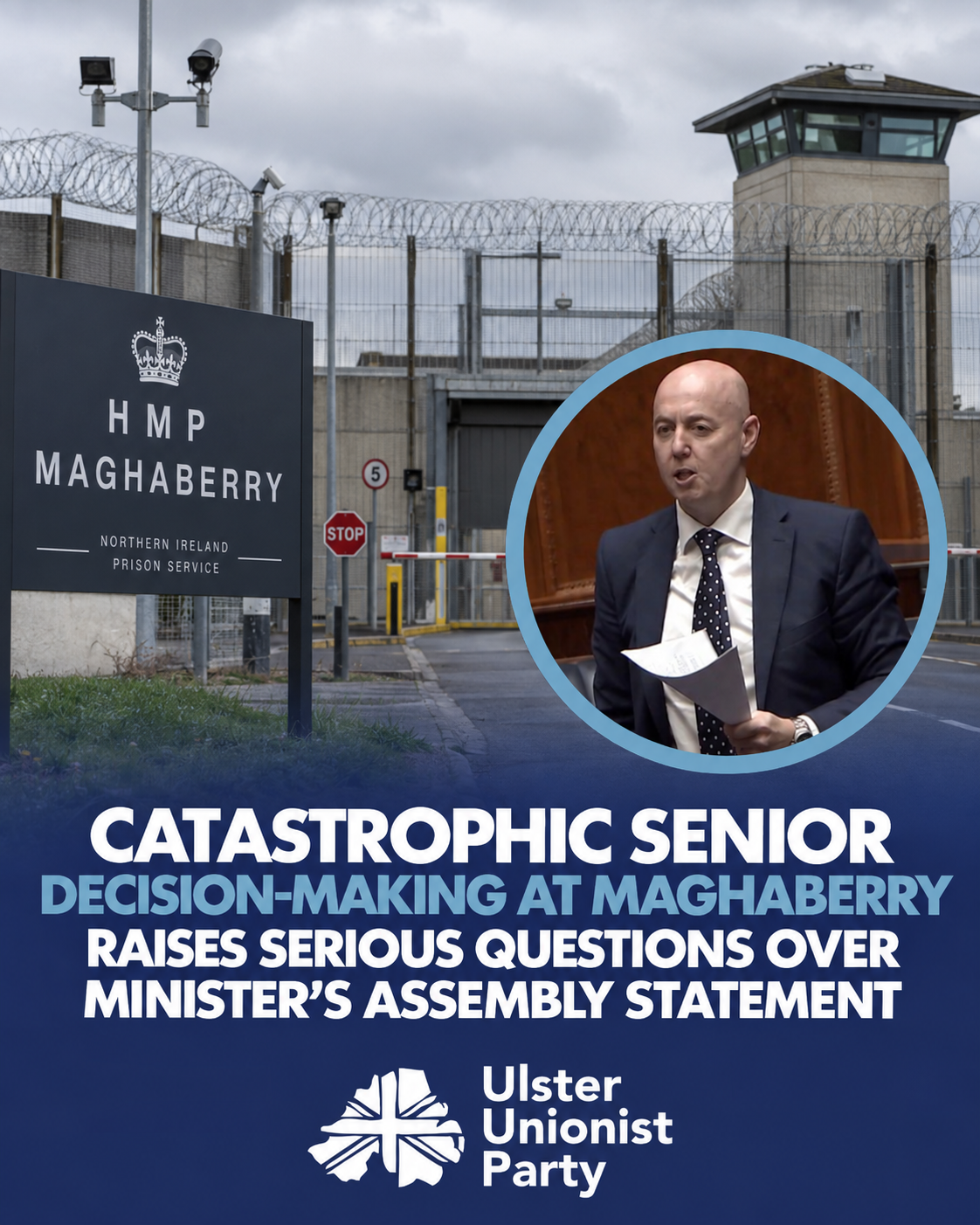
Ulster Unionist Party Leader Jon Burrows MLA has said a damning High Court judgment has exposed catastrophic failures in senior decision-making at HMP Maghaberry and raised serious questions about the assurances given by Justice Minister Naomi Long to the Northern Ireland Assembly.
Mr Burrows said:
“My first thoughts are with the family of Karol Kelly. They have already endured the most appalling loss and have now been retraumatised by the release and subsequent absconding of the man convicted of his murder.
“This judgment is damning. It exposes catastrophic and inexplicable failures in senior decision-making, procedure and record-keeping at Maghaberry Prison.
“The substantive decision to refuse Gary Anderson compassionate temporary release was, in my view, clearly correct. His subsequent absconding has only underlined the serious risk he presented.
“However, that decision was catastrophically undermined by incorrect information, missing records and an extraordinary refusal to reconsider it when the court provided an opportunity to do so.
“The refusal relied on incorrect information about Anderson’s assessed risk of reoffending. When checked during the hearing, the Prison Service could not produce the alleged updated assessment, and the colleague who supplied the information could not recall where it had come from.
“This was not a minor administrative error. The incorrect information went directly to the assessment of the risk posed by a convicted murderer and was expressly relied upon in refusing his release.
“When the error was exposed during the urgent hearing on Sunday, the judge gave the Duty Governor further time to locate the assessment and invited him to reconsider the decision using accurate information.
“That was an opportunity to correct the failure, prepare a fresh and legally robust assessment and potentially provide the court with lawful grounds to keep this dangerous prisoner in custody.
“Instead, the Duty Governor declined to reconsider the decision and left the matter in the court’s hands, without supplying updated, reliable and accurate evidence. The judge described this as a ‘somewhat surprising refusal’ and said that the court had been left with ‘no alternative’ but to order Anderson’s release.
“This was not simply a judge substituting a different view of risk for that of an experienced prison governor. The decision collapsed because it relied upon materially incorrect information, the assessment supposedly supporting it could not be produced and the Duty Governor refused the opportunity to reconsider.
“The judgment also raises serious questions about the assurances given to me by the Justice Minister in the Assembly.
“I specifically asked whether there were lessons for the Prison Service in how its decision had been ‘formulated, recorded or written down’ so that it would be more resilient to legal challenge. I could hardly have identified the problem more precisely.
“The Minister dismissed that concern. She told the Assembly that there was ‘no suggestion that the Prison Service misjudged the case’, that its decision was ‘correctly taken and was right’ and that she did not believe the Prison Service was at fault.
“She also told me explicitly that the Prison Service had ‘strongly resisted the release, even at the judicial review’.
“That account must now be reconciled with the judgment.
“The Prison Service may have maintained its formal opposition to release, but at the decisive moment, when the court offered the Duty Governor an opportunity to reconsider the flawed decision using accurate evidence, he declined and invited the judge to decide the matter.
“Declining to correct a catastrophically flawed decision and leaving the operational assessment to the judge is difficult to reconcile with the claim that the Prison Service ‘strongly resisted’ release.
“The hearing took place on a Sunday because the funeral was scheduled for the following morning. Prisons operate around the clock, and senior management arrangements must be capable of responding to urgent matters involving public protection.
“Why was the court’s offer not accepted? Who did the Duty Governor consult? Who authorised the decision to leave the matter in the judge’s hands? Why was an operational decision involving the temporary release of a dangerous convicted murderer effectively outsourced to the court?
“The precise concern that I raised in the Assembly, and which the Minister dismissed, was central to the collapse of the Prison Service’s decision.
“The Minister must now explain what she knew when she answered the Assembly, who briefed her and why she offered such an unequivocal defence of the handling that the court found to be fundamentally flawed. She should return to the Assembly at the earliest opportunity to clarify and, where necessary, correct the record.
“There must also be an urgent and independent examination of the decision-making, record-keeping, senior oversight and handling of the judicial review. Those responsible must be held to account.
“This is not criticism of front-line prison officers. It is about accountability for senior-level failures that created the circumstances in which the court said it had no alternative but to order the release of a dangerous murderer who subsequently absconded.
“I have submitted an urgent oral to the Speaker’s Office for the Justice Minister to come before the Assembly on Monday and answer questions about what happened.
“The family of Karol Kelly and the wider public deserve the full truth, urgent accountability and firm action to ensure that this can never happen again.”